Showing posts with label Nepalese. Show all posts

Thursday, February 6, 2014

A Himalayan Delivery; from a Writer's Eyes

A Himalayan Delivery; from a Writer's Eyes

The second half of my journey through the Himalayas bring me below the looming Annapurna Range without an ounce of technology. All my camera batteries, were as if, the life had been completely drained. Could it be the Universe trying to tell me something because for the first time in a long time, I was forced to write. Documenting my experience through prose was something I had not done in years. 


As I write, I sit at the top of the mountain ridge on a narrow cobblestone pathway with a steep drop on one side. Above me welcomes the uninterrupted apex of the snow capped Himalaya while below, across the ravine lay stairs of rice paddy fields in long column terraces intermingled with columns of trees. From the bottom, the sound of rushing water echoes off the canyon wall. I can't see the river from my vantage point, but I imagine sheer cliffs hugging large boulders that have intermittently fallen many a century ago.

A Nepalese girl walks down our stair. She has Tibetan eyes, rosy cheeks, and a blue and maroon stripped shawl over her shoulder.

"Namaste Biani," I say. She replies the same, then disappears within three steps over the ridge on our cobblestoned path.

I feel like I'm sitting on a stairway for giants watching them ascend up the terrace, into the mist while continuing the 18,000-feet more to their kingdoms in the clouds. We, the human is nothing but an ant; making our way over our own mountains and stairways.

I'm briefly interrupted by an elderly man carrying a basket on his back that is strapped to his forehead.  Dipak, my Nepalese brother whom I've been hiking with, speaks with the man.

"He carrie Roxy, local wine," Dipak informs.

"Ask him how many kilos," I inquire.

After a minute of calculation, he exclaims, "60 kilo Katie." The teahouses buy a great deal of Roxy for their foreign trekkers who will gladly pay top dollar after a long day's hike.

"Where does he walk from Dipak?' I say quite curiously.

They continue to discuss further in Nepali.

He departs every morning from the bottom of the mountain at 5am, walking continuously up steep stairs until he reaches his destination at 11am in the village of Ghandruk. The tea house gives him one glass of Roxy and pays him 250 rupees ($2.50) for his effort.

The frail man is 5-feet-tall.

Dipak gives him a cigarette and as the old man sits on the stair-ledge with an eternity behind him, Dipak crouches over to him and lights the tobacco. He chats closely with him speaking softly in Nepali. I imagine they are speaking about life and hardships, but also reflecting on the joys of living in this beautiful heaven of the Himalayas.

"Dipak, what are you talking about?" I eagerly solicit. 

He stands up with a laughing smile. 

"Oh this man he all the time walking 60 kilos. So all the time drinking Roxy. So Katie, what'cha ya do? I say. This man, drinking and walking big problem for you! Even-ing time big problem!" he explains.

Dipak's good heart is trying to convince the man to stop drinking while walking the great Himalaya.

He continues.

"Then he say he has wife; and son in Dubai; and three daughters stay in home. So he working all the time money for family. So Katie, what'cha ya do? I say." 

I'm saddened by this man's tribulation. I've just finished walking six hours along this same path with no load upon my back. It's beyond arduous; the up-and-down thousands-upon-thousands of stairs, climbing ridge-over-ridge. I couldn't imagine doing what he does, every day, at his age, for $2.50. 

I think life can sometimes be quite egregious. Observing others can allow one to reflect upon their own struggles realizing that we really have none in comparison. 

Dipak stands up from his crouching position and informs me that it's time to leave.  I want to take a picture of this moment because it has been so special for me, and I'm saddened by my failing equipment.

I'm going to try to turn on my camera, I protest.  Pulling all the energy I can muster from my surroundings, I place my hands one last time on my camera. A surge flows from my fingertips.

It turns on; just long enough for one solo picture of Dipak and the old man.

Then, just as the wind carries away the moment, the camera shuts down and the man too picks up his basket and disappears over the ridge to continue on his journey.



Friday, March 1, 2013

We came to buy a cow; they wanted a school

We came to buy a cow; they wanted a school

How a 23-hour bus journey, an idea lost-in-translation, and a bout of E.Coli helped shape one backpacker's destiny and transformed an entire village.


40-minute walk to the village school site.

Blog originally written August 2011.

Traveling through the Himalayan foothills at night by bus might not be the safest method of travel.  The road ahead is windy, it’s generally safe to assume a 500-foot drop is on one side, and the only thing you can see are the headlights from an oncoming bus as it swerves back into its own lane to avoid a near-miss collision.

Though dangerous, night travel was inevitable as our twenty-hour journey brought us from the Himalayan foothills to the jungle lowlands near the Indian border of Nepal.  As we stepped off the bus, the calidity began to stir-fry our brains as a single sweat bead rolled off our foreheads.  It was like an oven – hot and miserable, hundred degrees with humidity, and miles from anything remotely considered civilization.

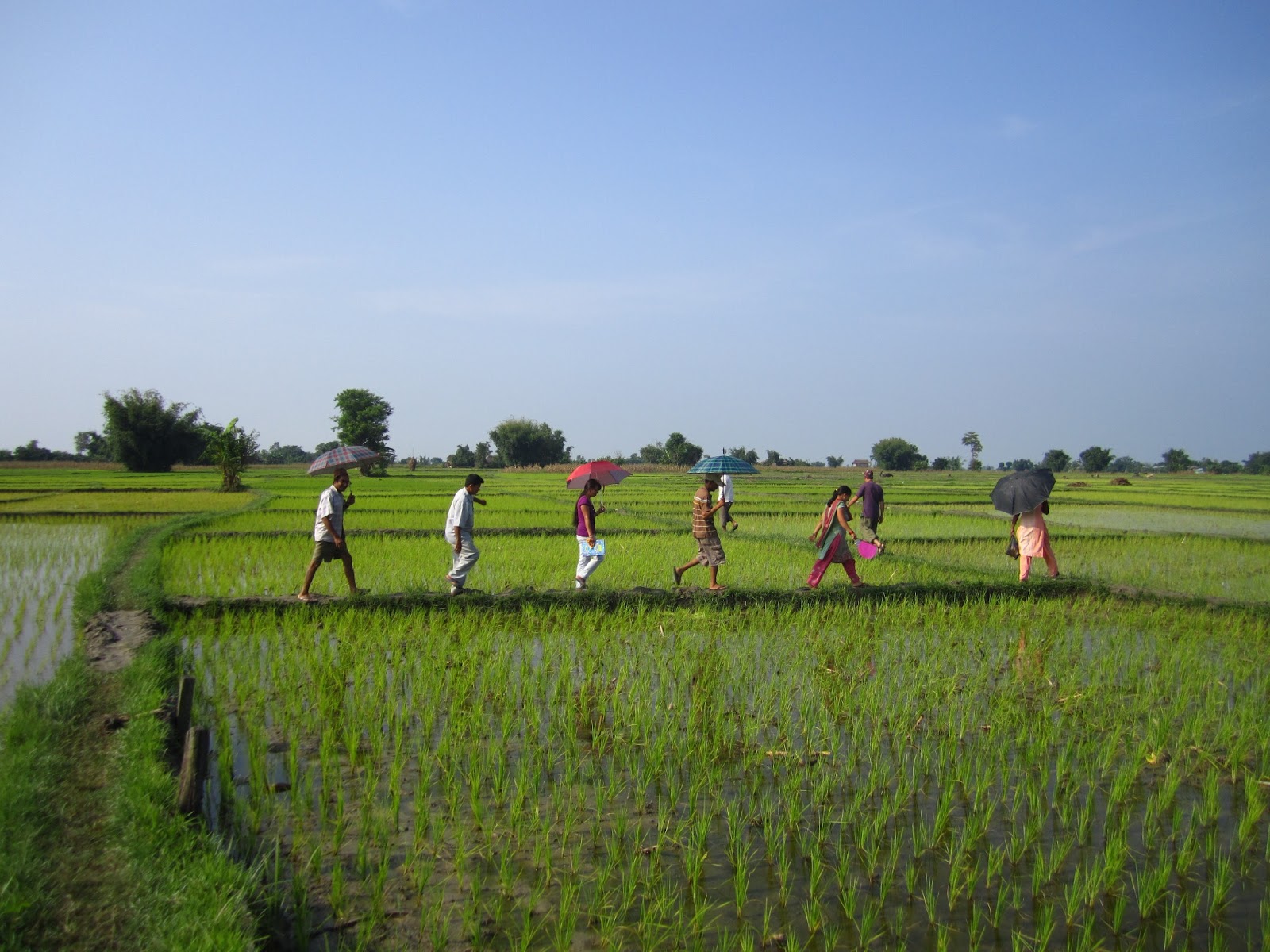
The villagers of Udaypur welcomed us with open arms and a nicely prepared curry.  Their wood huts on stilts, above water-filled rice fields added to the Asian ambiance and intrigue. 

They were happy to see us, as my Nepalese friend brought me with to see how I could help.  After purchasing cows to give families a form of sustainability months prior, I thought this was a perfect way to spend the remaining dollars in my fund.

So you’ll understand my surprise when all they wanted was a school.  My plan had obviously been lost-in-translation.

"Um Dipak, why exactly do these people think I am here?" I asked inquisitively. "Do they think I am coming to build a school?'

"Oh yes yes Katie, just see how we help. No worries," he replied nonchalantly.

But the fact remained that they indeed wanted a school.  They had enough cows to last them a lifetime.   The $500 that I brought with for the purchase of a cow was erroneous. Had I traveled all this way for nothing?

I was disappointed, but ate my curry dinner that was so eloquently prepared. The following morning I woke with a bout of E.coli. Nothing is more enjoyable in life than being plagued with a stomach bug in 100 degree heat with no toilets or running water.

I was miserable and nauseous; I could not even pull myself up from the straw bed.  The outhouse in the back did not suffice my wailing woes.

But even still, the villagers insisted that I make the journey to the school site the following day. I was under the assumption that this would just be a preliminary visit.  Little did I realize, they had planned a ceremony in my honor that I was meant to attend.  We made the 40-minute journey by foot crossing through rice plantations to the school site.

Fainting under the jungle sun shortly before ceremony
I was in no condition to do much of anything. The walk was long and laborious. Fainting under the jungle sun five minutes prior was really my last draw.  Going in-and-out of coherency during the entire walk to the school, I questioned my decision in coming to the village and immediately wanted to go back to the comforts of Kathmandu.

Upon standing back up, I saw the hundred or so people from a distance.  

“Oh my God! Quick, full power,” I exclaimed as a little Nepalese lady fanned my face and put my hair into a pony tail.

I could not believe I was walking into a ceremony when I couldn’t even stand on my own!  I splashed some water on my face to shake it off and on we went… with a person helping me on each arm.

Unexpected ceremony from the villagers
They adorned us with flower necklaces and each child presented a gift. I felt like I was hallucinating from a combination of the heat, the illness, and the fact that I was in the strangest place and participating in a ceremony so foreign to me.  I was ecstatic, but also disappointed that one of the more special moments in my life had to be overshadowed by the E.coli.

I tried to stay collected as long as possible, but eventually ran off the stage to vomit into the bush.  It was all a bit comical, as the children came running over to hover around and the village women were rubbing my back. 

After another two days of rest I was strong enough to start eating again and collected my thoughts.

The village needed a school.  The elders knew it was the only way for their children and generations below them to escape the endless cycle of hard, manual labor. They work the rice plantations from the time they can walk until the day they die. I met with the elders to discuss options.

Meetings with the Village Development Committee discussing options for a school.
I thought I was coming to the village to buy a few cows and was in no position financially or resourcefully to build a school.  I am just one woman, I kept thinking to myself.  How can they expect some backpacker like me to build an entire village a school? 

I still did not conceive how this project could be funded, but then, just as serendipitous moments often occur, there was a secret donor amongst our group. My French travel companion gave his Buddhist necklace from around his neck and placed it on mine.  

“It means invincible and whoever wears it is just that. Here is some money to start the school. You come back and finish it.”

The Village Development Committee
It was just enough money for the foundation and enough belief from someone for an idea to be born.  The entire following year back in States will be a long and arduous work of collecting funds for the Koshi Tappu Primary School.

As I hopped on my bus about to head back up into the foothills, the children came running behind it waving goodbye.

“I will return,” I told them. “This is my promise to you.”

Update: Katie returned one year later with the funds as promised.  The school is now complete as of November 2012.


Friday, February 22, 2013

Nepal Mob & Barricade Footage

Nepal Mob & Barricades


*This blog is the accompanying footage for a previous blog, found here.


I returned with funds in Summer 2012 to finish the school I started one-year prior. While driving to my school site in Nepal, I encounter a Banda (strike). Assassination attempts on political leaders occurred that morning.  The leaders barely survived, and at the time of filming, the outcome looked bleak. Unaware of the reasons for protest, I face several mob barricades, and plea with locals to let me pass.


Friday, July 6, 2012

Mobs, Barricades, and Schools Oh My!

Mobs, Barricades, & Schools - Oh My!

We arrived in Bhagalpur late last Monday night, nearly past midnight.  It took much longer to get there than any of us had imagined.  16 hours to be exact, about six more than what was projected.

We had the usual mishaps along the way!  And by usual, I mean in the Nepalese sense.  Possibly for any other country, what we encountered would be quite unusual.

Assassinations, Strikes and Roadblocks:

Shortly after our departure, a Banda was called in response to an assignation attempt on three leaders of the Maoists Party.  If you recall, the Maoists were responsible for the overthrow of the King in 2006.  They rebelled for the decade prior seeking political and social change.  The Maoists were the peasants who saw a change in leadership ideal for their voice as commoners.  Through propaganda (some believe), the rest of society was convinced of the need for this revolution.

However, after six years since the overthrow, Nepal has gotten much worse.  Those who originally supported the cause are now rethinking their positions and many believe the monarch was better for the economy.

My position is still unclear.  I can only communicate what I see, and what I see is a dwindling currency, a country without a constitution, I see corruption at every level (particularly police and politicians), I see rising prices for dry goods and produce, and I see innocent villagers suffering the most at the hand of an unstable government.

Nepal, I fear, is at the brink of an economic downturn and a political uprising.  There is no real (or least respected) leader.  The Prime Minister they do have gets booed in public while university students hold protests calling for his resignation. Now yesterday, three leaders of the Maoists have been shot with the intention to kill.

Bandas (strikes) were called closing down all roadways.  The one road in and out of the Kathmandu came to a standstill.

We were held up for hours while traffic was blocked in both directions.  It was a full-on gridlock of Nepalese vehicles, sometimes four deep on a narrow Himalayan mountain road meant for two.

I felt like the crowd of people standing around and in-between the cars, buses, and motorbikes were going to accidentally push me off the 300-foot ledge drop.  I retracted away from the cliff and sat back inside the small hot Suzuki taxi decked out in racing strips we hired to drive us from Pokhara to the village. (Not that I prefer racing cars for cross-country road trips, but these are the norm for taxi appearance!)

“This could take hours!” I professed quite loudly with a huff of frustration.  “I have a school to build!”

Another hour passed while sitting in gridlock.  I myself was melting from the exhaust blowing into my window from the large buses that had us surrounded on three sides.  It was taking everything in me to not storm right up to them and demand that their engines be shut off.

But alas, my annoyances were met, as traffic started moving again.  Someone, somewhere had the idea to walk up the mile-long traffic line and direct the smaller cars and micros to pull through while the buses waited.

Rounding another two corners, it was clear to me that we were going nowhere fast.  Further, up the road in Munling, the road splits off; those going to Pokhara veer right while anyone wanting to head down to the Terai must take the left.  Pokhara traffic was given the green light; everyone else would have to wait until 5pm when the strike was finished.  It was 10am when I heard the news.

“We must get through,” I pleaded with Dipak, Nabin, and the taxi driver.

“Oh no, this is impossible Katie,” Dipak explained.  “They don’t let anyone through during Banda.

I refused to take ‘no’ for an answer and stormed right up to the mob of people blocking the road.  They looked like they were about to riot.  During Bandas, the mobs will generally injury the drivers and demolish the vehicles of those who try to pass the barricade.

This information did not deter me.  I put on my charm and pleaded with them to let me through.


“I’m building a school for poor people in Koshi Tappu!  I must get through.  I have very limited time,” I explained in the most sincere voice.

After 15 minutes of Nepalese negotiation, I think someone said okay, so I ran back around the corner and motioned for the traffic driver to start pushing our vehicle through the herd that had considerable gotten bigger since I first spoke.

They searched the vehicle for our contents to confirm we were headed to Koshi Tappu for this school project.

There was chaos while I escorted the car through the crowd.  People were yelling and some looked very angry that I was trying to break the barricade.

We eventually broke free, and with the largest smile I could muster, I kept repeating ‘Dand-u-bhat’ (thank you) as we walked away.

Excitement filled the car as we sped off down the gorge.  The plus side was that the roads were now clear for hours.

The negative side, we had to go through several more police checkpoints and one final mob barricade.

The Village and Project:

The school is half way finished.  There had been another delay due to electricity problems.  The carpenter who is making the doors and window frames only has electricity for a few periods in the day for use of his table saw.  If we recall, Nepal participates in load shedding, which means power is cut for several large portions of the day/nights for sale to India.

The villagers haven’t been able to work full-time for this reason.  They’ve built as much as they can of the structure, but until the doors and window frames are installed, they cannot continue.

This puts construction back one more month.


I made the 45-minute walk to the school site from Bhagalpur, where we are staying.  Dipak’s Aunt and Uncle have graciously allowed for use of their home.  Ba (grandfather) has given me his bedroom, which comes with a fan and several breezy windows.  It is more than generous.

That evening, we had Pork Dal Bhat!  They killed a pig – it was nasty as I predicted, but I kept reminding myself that bacon is delicious.  Providing I didn’t find any eyeballs in my curry, I kept thinking I could manage this beast.

I have met the 10 labors, three on-site managers, and four teachers.  I presented the enrichment material that I purchased in Kathmandu.  The teachers were more than ecstatic.  Though minimal by American standards, I had to remind myself that sometimes the best can't be done.


There’s a dozen or so ways to create the perfect classroom, but in Nepal that is just not possible.

I bought every chart that was available from Everest Publishing Company!  I literally took their catalog and ordered one of each.

Then I went to ETK Books where I purchased more charts (Good Habits, Medicinal Plants, Parts of a Body, Multiplication Tables).  I tried to find the most useful visual aids but considering what I have to work with it’s difficult.

I started compiling the books for the library from the government bookstore.  My Nepalese friend Yogi took me to all the shops in Kathmandu the week prior

Buying products here in Nepal is not that simple.  They really don’t have warehouses or bulk purchase options.  You really can’t order online or even over the phone! There definitely aren’t any websites.  

So first, how did I go about this?  Trial and error I suppose.

First, I went to a local primary school and got the name of the bookshops where the textbooks and charts were purchased.  Then I went to those bookshops, which then directed me to the publishing company.  Often times, the publisher was in India, but the ones located in Nepal I was able to drive to.

This process took the entire day!  However, once I finally arrived to the source I was able to negotiate a discount on my purchases.

“The American people are paying for the school to be built,” I explained. “Now I ask that the Nepalese people help contribute to the cause as well.”

This generally seemed to touch their hearts in some form, and every place I visited was able to give me a decent discount.  One publisher donated an entire series of textbooks for the teachers to use!

What the Teachers are Asking For:

At the moment, school enrollment has increased from 75 students to now over 100!  As soon as the villagers heard of a new school being built, many enrolled their children. 

Wonderful news of course, but now this means that our original building size is too small! This also means that two more teachers need to be hired!  Let me worry about the school addition later, but right now, we must focus on finding the funds to hire more teachers.

I am exploring all options for funding, with a focus on sustainability.  Yes, I could pay the teacher’s salary for one more year, but this does not solve the problem after I’ve left.  We need a more solid form of funding, and I’d like to focus on income generation for the school.

I’d like to continue my idea for the Sivapuri ‘low-caste’ Primary School I visited outside Pokhara a few weeks back.  That being, using animal husbandry as a source of income generation for the school. 

I’ve discussed my idea with my on-site managers in Tappu and they are keen to it.  We are exploring options of a possible chicken farm.  A simple investment for me, but a large return for them.  Just like the Sivapuri Income-Generation Project, this school too could wreak the benefits from this type of sustainability.

Every two months, 200 chickens could yield 108,000 rupees (US$1241).  That’s 648,000 rupees ($7448) a year.  The annual salary for four teachers is 384,000 rupees ($4413).  We are still calculating the overhead, but the possibility of a decent profit margin is very feasible.

I will leave you now with this notion of sustainability fresh in your heads.  I am open for suggestions if anyone would like to give their two cents!

Look back in a few days for an updated blog!